



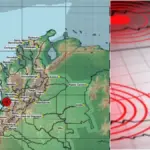

Although Bogotá is more than 200 kilometers from San José del Palmar (Chocó), the epicenter of last Monday’s earthquake, and more than 400 kilometers from other affected cities like Cali or Armenia, the emergency has been felt as if it were their own.
From the capital, citizens have overwhelmed the more than 10 official collection points with tons of food, water, mattresses, hygiene items, and even construction materials in order to support those who have needed it most in the rest of the country.
The image of the last few days in Bogotá has been moving for everyone: thousands of people line up with their hands full of products, and those who bring nothing offer themselves as volunteers to form human chains and organize the goods side by side with professionals from the Mayor’s Office and the Red Cross.

“The most touching thing is that people come to contribute even if it is just a pound of salt. Those who cannot provide material goods help with their labor in the logistical process of sorting food and packing boxes, a painstaking job for those who do not bring pre-packed groceries. Also, the solidarity with pets has drawn a lot of attention, as many donations of animal food have been received,” said Guillermo Escobar, director of the District Institute of Risk Management and Climate Change (Idiger), in an interview with EL TIEMPO.
From El Campín, Vive Claro, and Unicentro to the Palacio de los Deportes and the administrative headquarters of the Red Cross: thousands of people have come to all of them to ask what can be done to help, what items are urgently needed, and how they can volunteer.

Empathy has been the driving force for the lines to remain until midnight at each collection point, since, although the earthquake in Bogotá was only a scare, for other Colombians it was the beginning of a true tragedy.
“Nothing happened to us, but in moments like these there are plenty of reasons to decide to help. From our family business, we wanted to bring some trucks with 100 water jugs and 300 water containers. It’s our grain of sand,” said Rafael Sánchez, representative of the company Agua Santa Clara.
Although solidarity is a feeling, it can be measured with numbers, and in Bogotá the mobilization has been monumental.

According to the Government Secretariat, by the time of this edition more than 185 tons of items have been collected in just two days, which is equivalent to filling 10 average-sized passenger planes with donations.
“Bogotans have really stepped up and shown immense solidarity. We have had the points overwhelmed with people arriving with cars full of groceries. It is a great joy to see how we want to help those who need it most,” said the Secretary of Government, Gustavo Quintero, in an interview with this newspaper.
One of the key points for this donation has been the administrative headquarters of the Red Cross, in the 7 de Agosto sector. For the first time, traffic jams stopped being a nuisance in Bogotá; this time, because they were cars carrying even mattresses tied to the roof to be donated.

“I am from Pereira, but I am in Bogotá. It is a bit frustrating and painful to be far from home and not be able to help. That is why we brought water, non-perishable food, wipes, diapers, alcohol, and what my family members have told me they need over there. The invitation is for everyone to keep donating a lot, they need us,” said Antonia Vélez, one of the donors at the collection center.
Another site that has been fundamental is the Palacio de los Deportes, the only one where aid is being received exclusively for the department of Chocó, one of the territories most affected by the emergency.
“We spoke with the Governor’s Office and learned about their special needs. Just on the first day, we managed to collect 58 tons of donations, of which we have already dispatched 19 in five trucks that are already in the department. In the coming days, we will send more than 40 tons with more vehicles and with the support of a Hercules plane,” detailed Lina Lozada, Deputy Secretary of Government of Bogotá.

This coliseum, like the other points, has mountains of diapers, groceries, water, mattresses, and pillows, but it has a particularity. Construction materials are being collected there to remove debris and rebuild thousands of homes.
The Governor’s Office of Chocó expressly requested construction materials ranging from cement to bricks, picks, and shovels to rebuild the department.
Companies in the sector have brought tiles, tools, gloves, and flashlights to the Palacio de los Deportes in response to this special call made by the authorities.

Although Bogotá has shown “that the only cold thing it has is the weather and not its heart”, the Mayor’s Office and organizations ask that support be sustained over several weeks and not just during the current situation.
“The needs in the affected territories will last for several weeks; people eat every day and the conditions of vulnerability extend over time until early recovery of homes and essential spaces is guaranteed. This is not a temporary action due to heightened sensitivity, it is a long-term process while the regional productive apparatus is reactivated,” concluded Escobar.
NICOLÁS DÍAZ MALPICA
Bogotá Editorial Team