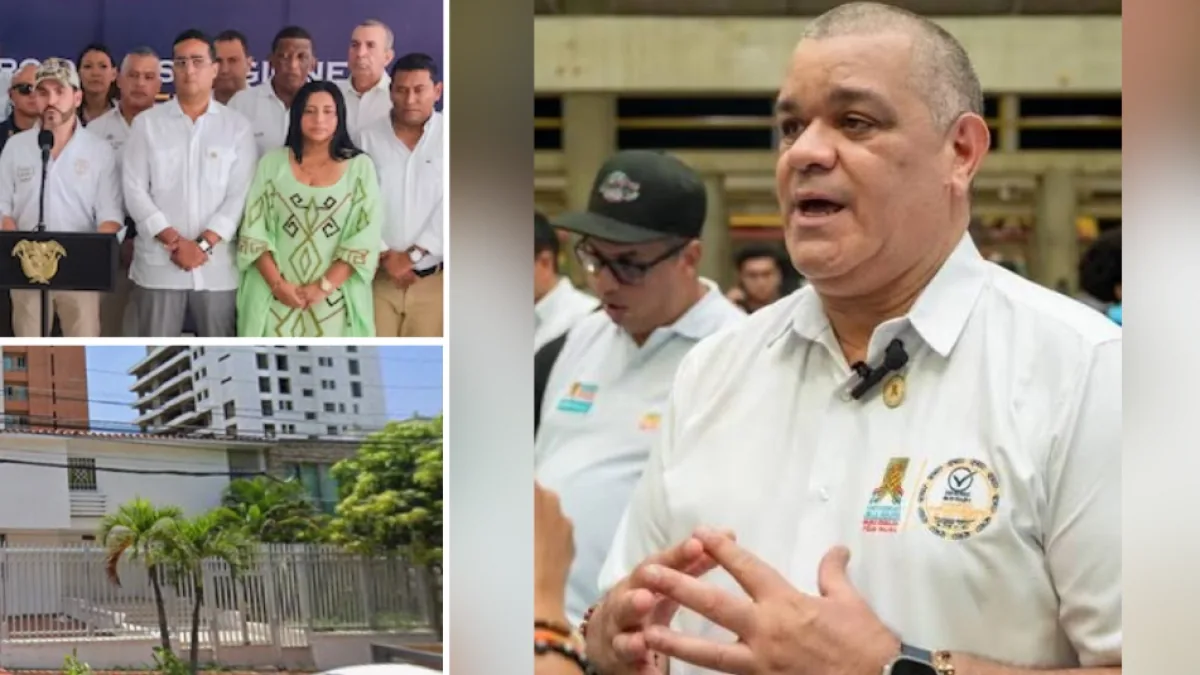









One of the inheritances that the government of Abelardo De La Espriella receives is a package of seven contracts that the National Institute of Roads (Invías) awarded 10 days before the administration of Gustavo Petro expired.
The amount exceeds two trillion pesos and the purpose is the improvement and maintenance of roads in La Guajira, especially those used by Wayú indigenous communities settled in rural areas.
De La Espriella’s transition team asked that they refrain from signing the billion-peso contracts, which would commit future budgets for at least nine years. In fact, although no details of the process were given, Elsa Noguera, the new Minister of Transport, questioned the contracting, which sparked a spat with her predecessor, María Fernanda Rojas.

EL TIEMPO’s Investigative Unit investigated and established which companies ended up securing the last-minute billion-peso deal; there are firms behind mega hotel projects in Cartagena (with more than 10 years of delays) as well as well-known family clans involved in corporate controversies.
Additionally, this newspaper learned of several substantive observations presented by companies interested in the contracts that the De La Espriella government will request to be reviewed.
Uncertified experience?

One of the criticisms points out that Explanan SAS, a member of the Consorcio Conexión Invías 062 —which was awarded lot 4, which runs from Jojoncito to Taparrajín (La Guajira)—, failed to present all of its ongoing contracts. This would prevent evaluating the residual capacity of the bidder, an indispensable requirement in the bidding process.
In fact, the observation states that this is a possible cause for rejection.
According to the terms of the billion-peso contract, the project in general includes roads of Wayú communities residing in dispersed rural areas, according to the Roads for Peace program.
The first road corridor includes drainage works, riding layers, and even bridges, corresponding to a road of approximately 35 kilometers between the villages of San Martín and Nuevo Ambiente.

That contract was awarded, for 280 billion pesos, to the Consorcio Proyectos Guajira, represented by Stiven López Betancur and made up of Intack SAS, Diseños y Construcciones PT SAS, Ingeniería Vertical Ing SAS, and Construcciones e Inversiones Beta SAS.
Industry players told EL TIEMPO that this last company was a partner of the so-called Grupo Ocean, responsible for the mega project Ocean Tower, two luxurious apartment towers and even a hotel facing the beach of Bocagrande, in Cartagena.
“That project, which was to be delivered in 2015, today is just an abandoned structure,” they explained.
For lot 2, which corresponds to the Nuevo Ambiente-Nazareth road corridor, the contract was awarded for 270 billion pesos to Consorcio LHS Guajira 2, represented by Gabriel David Solarte and made up of Constructora LHS SAS and Solarte Nacional de Construcciones SAS.

Both companies are part of the so-called Solarte clan, the well-known family of builders in Nariño that today has corporate disputes that have been aired in the media and even have them facing each other in an arbitration tribunal.
Solarte Nacional de Construcciones SAS, which holds 90 percent of the consortium, has had contracts in past governments with entities such as Aerocivil, for the construction of runway structures in Ipiales, Nariño, and with Invías itself for bridge construction in Putumayo.
In the case of lot 3, which includes the road between Uribia and Jojoncito, the contract was awarded to Consorcio San Marcelo 062, for 279 billion pesos.
EL TIEMPO investigated and established that the company with the largest share in the consortium is Ingeniería, Transporte y Maquinaria SAS, a company that has had contracts with municipalities in Antioquia for road paving, demolition, and bridge construction.

Another consortium that ended up with contracts in La Guajira is Vías para La Guajira 062, made up of the companies Ingeniería y Vías SAS BIC and R. P., which was awarded sector 5 for 280 billion pesos.
And lot 6 was awarded to the consorcio Isla Uribia, made up of Ismocor S. A., Latinoamericana de Construcciones S. A., Agregados de la Sierra, and Construcciones Iruma SAS, for a total value of 280.222 billion.
Transition observations

Additionally, the De La Espriella government is concerned that seven of the million-peso contracts are concentrated in Uribia, La Guajira, with a value close to 2 trillion pesos.
They also claim that signing would condition the incoming administration to fulfill several commitments, including future budgets.
For Minister Noguera, while tertiary roads are a priority for the new government, the express signing of the contracts raises doubts and sets off alarms: “But what many Colombians have the right to ask is why, just days before ending their mandate, the outgoing government awards Invías contracts for more than $3.2 trillion pesos, committing public resources and future budgets until 2035. I announce that each of these processes will be reviewed with absolute technical, legal, and financial rigor as appropriate.”
Less than an hour after that tweet, former Minister María Fernanda Rojas responded that these are processes that have been planned since 2025, supported by contracting law: “A public tender was held with all guarantees (firms with full technical, legal, and financial capacity participated).”
She even said that the Petro government respected the future budgets signed by the Iván Duque government and even reproached Noguera for ending the transition: “If she had attended the transition, along with the team we were informed would attend, she would have clear information.”
And for 280 billion, lot 7 was awarded to the consorcio Vial de La Guajira 062, made up of Biomaquinaria y Equipos SAS, CFD Ingeniería SAS, and Servicios Industriales Colombianos SAS.
No points?

Regarding this consortium, it is claimed that Biomaquinaria y Equipos SAS submitted a document to obtain points for disability, but delivered said form signed by its fiscal reviewer and not by its legal representative.
In fact, it asked Invías to deduct the points assigned for the component of people with disabilities, which could exclude it.
Regarding the new government’s alerts, Invías issued a statement on August 5 in which it addresses the issue: “The contracts do not correspond to decisions made improvisedly nor to processes initiated in the last days.”
The Invías versionThe outgoing director of Invías, Juan Jiménez, assured that if the files had been reviewed during the transition process, it would have been possible to verify that these are actions started several months ago and not last-minute decisions.

They even mentioned that for the work contracts 105 proposals were submitted and that the National Development Plan remains in effect until the Congress of the Republic approves a new one. However, the De La Espriella government assures that they will carry out a technical, legal, and financial review of the processes.
(Consult here all the articles from EL TIEMPO’s Investigative Unit)
EL TIEMPO called the seven consortia to inquire about the million-peso award and doubts about the process, but by the time of this edition only two responded. Andrés Restrepo, representative of the Proyectos Guajira consortium, said that Invías has not communicated anything different than that the contract will be legalized and that they are already sending the documentation for that procedure.
And Jorman Andrés Sosa, representative of the Consorcio Vial La Guajira 062, stated that it was a totally transparent process: “Many observations were presented by several bidders. If the incoming government wants to review, it will find nothing.”
The controversial contracts at Invías are part of a package worth 2.1 trillion pesos divided into seven awards.
INVESTIGATIVE UNIT
u.investigativa@eltiempo.com
@UinvestigativaET
Follow us now on Facebook
Read more From X to YouTube: this will be the digital communication style of the new government
Read more Government’s economic agenda receives vote of confidence; but now the real challenge begins