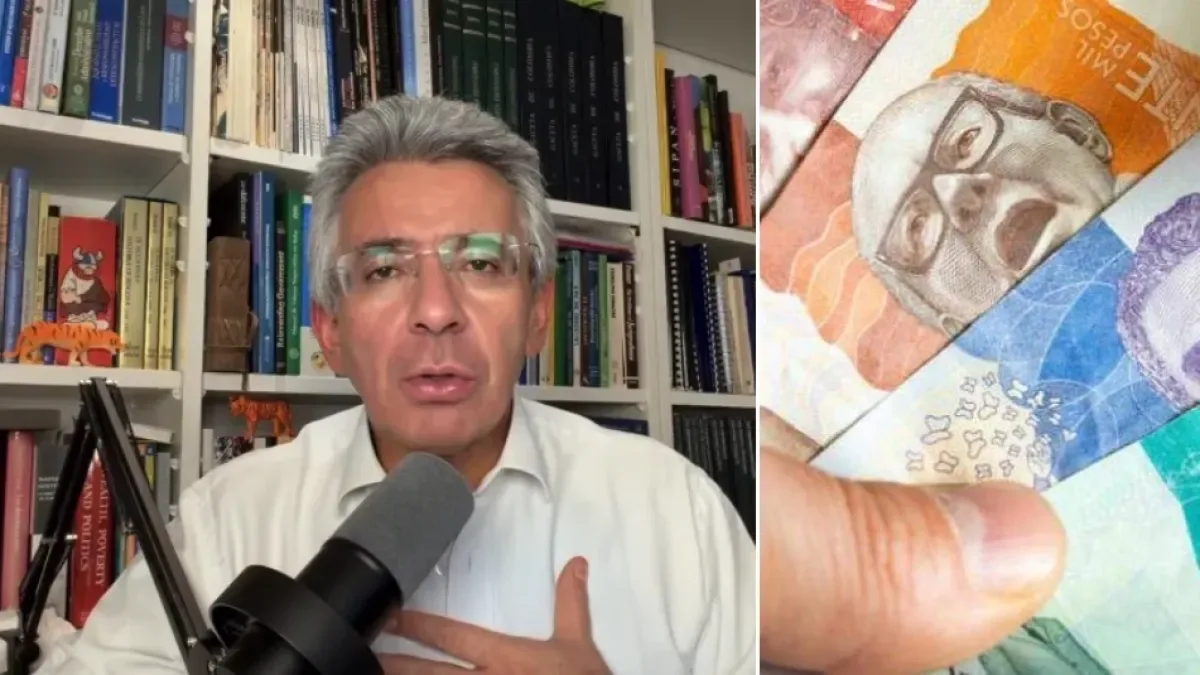





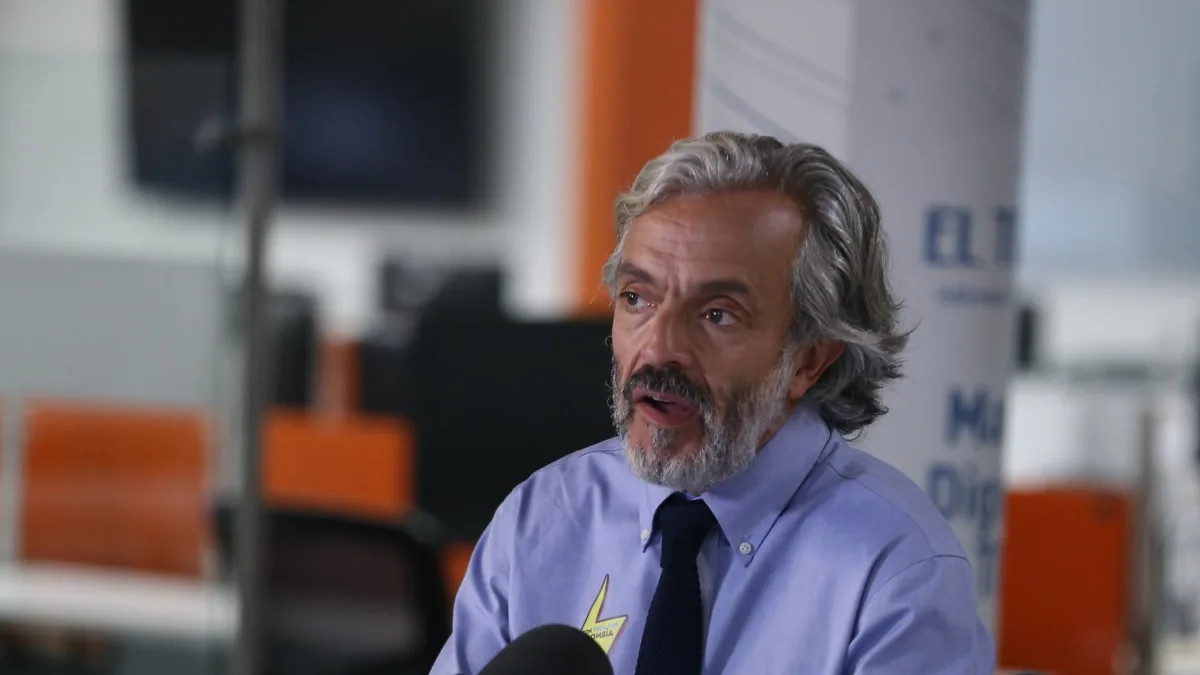
María Isabel Rueda spoke with Juan Daniel Oviedo, Paloma Valencia’s former vice-presidential running mate, about the possible reasons for the tough defeat last Sunday in the first presidential round. He also gave clues about where his vote would go, although he asked tough questions to both candidates.
Hello, Juan Daniel, how beaten up are you?
I am happy because, at the time of recording this interview, I am celebrating one year after having registered the significant citizens’ movement “Con Toda por Colombia” to collect signatures and get here. And there are many positive lessons. The first is that the country does need a stabilizing agent. It is in a moment of instability, like an adolescence in which we are unrestrained and a little careless with our institutions, with our rules of the game. Keeping one’s word and the rules is ceasing to be profitable or beneficial in the country. People want stability, they want solutions, after traveling the country by bus and visiting more than 70 cities, having so many conversations, and it allows me to feel satisfied that in La Gran Consulta, on March 8, I had the opportunity to obtain one million two hundred fifty-nine thousand voters, with a feeling far from caudillismo or political strategy: a feeling of respect.
Well: it was like eight hundred…
One million two hundred fifty-nine.
The same as Sergio Fajardo?
A little more.
I want to talk to you in this interview about the future, but let me ask you first: to what do you attribute the Paloma-Oviedo option dropping so much?
First, because it is important to recognize that bringing Álvaro Uribe Vélez into the conversation of La Gran Consulta, nominating him as Minister of Defense, scared away the center and even generated a feeling of contradiction in the country. Because, of course, many people respect the legacy of President Álvaro Uribe Vélez, but no more. More than 20 years have passed since he left power.
But you, when you were invited to that campaign, knew that Paloma’s great inspirer was former President Uribe.
It is different that Paloma has a mentor, as she says, who is Álvaro Uribe Vélez. But it does not imply that the mentor becomes part of the cabinet with a message of recovering democratic security, when the country’s crime problems today are very different.
Yes, there were many mistakes; but, isn’t it your way of avoiding a very important debate, such as the fact that many people were scared away by your unmistakable diversity?
Oh, no. Also. Among several causes, that is one. Others were my expressions of disagreement. People think that not agreeing is becoming anti. So, when I have publicly expressed that disagreement, Paloma has come out to say that she is the president and that she makes the decisions.
But, Juan Daniel, I’m sorry, didn’t you agree beforehand that this spectacle of disagreements between the two of you would be better held in private, under agreed rules of the game?
The rules of the game were there. But part of the principle of that La Gran Consulta por Colombia coalition was to let each of us be elements of a sum. And that quickly generated confusion among citizens, to which was added the incorporation of sexist and homophobic prejudice. From the beginning, my candidacy in that vice-presidential formula began to be attacked by Christian activists, saying that I promoted the hypersexualization of children, sex change in children. That attack was very strong. And it was added to the sexist attack against Paloma, which Abelardo de la Espriella initiated with his spectacle before female journalists in two important media outlets.
I was very hopeful that certain parameters of the country would change, being a woman and a gay man. But wasn’t that like an atomic bomb for a lot of people?
I don’t think so. Part of the principles in La Gran Consulta is that we were going to focus on how to stabilize Colombia, to respect the Constitution of ’91, to face the crisis of insecurity, health, energy, trust, and corruption that the country is experiencing. And I believe that around me was not the ideological debate that was being raised for these elections. We wanted to offer a propositional debate around a path to solution for Colombia to look towards that future. But, from the beginning, the differences or scars, let’s put it that way, that Paloma and Oviedo were bringing together in this duo had an ideological tint —the peace agreement, the JEP, respect for the rights of the population with diverse sexual orientation and gender identity—, a number of rumors and false news were generated around these positions that perhaps undermined the cohesion of the duo.
With all due respect, I ask you: was the only failure then that Paloma called on Uribe too much?
No, I’m not saying that. I also recognize that the attacks against me played a role. We were able to investigate: for example, in Antioquia during the last two weeks, there was a promotion to move the Uribista vote that was in the Paloma-Oviedo duo towards Abelardo de la Espriella.
So, to a large extent, it was a defeat against diversity?
Yes. In the Democratic Center, first of all, the formation of the duo generated many tensions around my sexual diversity and my positions. In addition, it was used as an argument by the right to launch a homophobic discourse against the Paloma-Oviedo duo, to which was added the sexist discourse of minimizing Paloma simply for being a woman. And to that were also added the attacks from the left, who said that I was renouncing my dignity of sexual diversity, that I was turning my back on the LGBTQI+ community. And the attacks from the center, from Fajardo and Claudia, who said that I was not a leader of the center, but a hidden Uribista. So, everyone began to generate distrust around this valuable sum that Paloma and Oviedo were proposing in that project.
So, future. What will Juan Daniel Oviedo do with his political capital?
Well, at this moment I differ that such political capital exists. I do believe there is a reputation. I cannot say that I have millions of voters. I have people who trusted that I can do politics differently. La Gran Consulta was a moment to think, in draft, about the future of politics. They found it super interesting that I was honest, authentic, that I said I was looking for a job, that I went into debt to run my campaign, that I simply said: “I’m looking for a gig,” as they say on the street. That sincere and realistic bet to do politics differently captivated those people. But those people, in that environment of polarization, with the risky bet of joining the right in this coalition with Paloma, which to a part of the country smells of ‘false positives’, which generates the fear of returning to historical events that people do not want to see or feel again, well, it undermined confidence in this duo.
I reproach you for saying that now when you entered the duo perfectly consciously. But let’s not talk about the past, let’s talk about the future. What will Juan Daniel Oviedo do regarding the two possibilities that open up between Dr. Abelardo de la Espriella and Dr. Iván Cepeda? Which way will he go? And don’t tell me he’s going to stay in the center, because, at this point, what is the center? Do you have to cast a vote or not?
We are the center that does get wet, and that’s why today we come out to say: will you, voters, vote against the Constitution or against rights? A very strong dilemma that we face in this conjuncture.
We are talking about the vote that Colombians should cast. If you could give them a “hint” as to which of the candidates is best for the country…
We are here to give a sense of reality to this contradiction we face, which leads many people to vote for the lesser evil. It cannot be possible that we resign ourselves to this. That is why our invitation is not a matter of coffees or private meetings. It is a matter of speaking clearly and saying: well, what will happen to the Constitution? Candidate Iván Cepeda, will there be a constituent assembly or will there not be a constituent assembly?
Although they said no, it’s not a guarantee.
And candidate Abelardo de la Espriella must be asked: will you defend the rights of historically discriminated minorities? Will you accompany the United States, Argentina, and El Salvador in denying the gender approach and the differential approach for the trans population in United Nations resolutions, as Trump, Milei, and Bukele have been doing? Candidate Iván Cepeda, will you guarantee that the structural corruption problem of the Petro government will be corrected in some way? Candidate Abelardo de la Espriella, will you guarantee that the mega-prison system does not imply a suspension of judicial independence in a scenario of internal commotion? Candidate Iván Cepeda, what will happen to the mining-energy bet? Because we need subsoil resources to finance the social debt we have with the country. Candidate De la Espriella, how will the 40 percent reduction of the State that you propose be? We have to ask these questions openly and promote a public debate so that people do not simply stick with the idea of saying: “For me, Petro became a disease, get him out.”
Like a surgeon?
When one is sick, one looks for the doctor who promises to solve the problem. One doesn’t care if that doctor has a history behind him. The Colombian who voted for Abelardo de la Espriella today is only interested in Petro leaving. Yes, I started my political campaign saying that I wanted Petro to leave so that Colombia could have a responsible government that would stabilize the conditions of security, health, energy, corruption, and private sector confidence in the economy. So we need to promote that debate. That is what we want to do openly, not with coffees to go out and say that my voters have to do this or that. No. My voters are independent and have already made a decision. Those who considered Petro an evil they wanted to get rid of found in Abelardo de la Espriella a very simple and, perhaps, exciting populist offer. We must acknowledge it: to get that vote, he excited many people with the idea that he would fulfill that desire. And, on the other hand, Iván Cepeda not only calls on those who want a progressive bet in the country, but also a number of young people and people who are not willing to return to something that smells of the past of politics, with deaf and indolent governments that led us to culminate in a social outburst after the pandemic.
Juan Daniel, you talk about a surgeon who cures you. Who is your surgeon? Cepeda or Abelardo?
Today I don’t know, but between now and June 21, I will decide. Instead of remaining silent and letting things continue like this, without debates, we need clear talk. We need to call on citizens to demand that, if the two sides of the ring in this dispute have already been defined, at least we can get closer to not having such radical measures as those currently being used to further polarize this political debate. But we cannot deny that there are many people in Colombia who want to end the irresponsibility and neglect that has characterized Gustavo Petro’s government. But I also hear from other people: “After 50 years in which the ‘tie-wearers’ governed this country and did not solve the most important social problems, which emerged during the pandemic and ended in a social outburst, it cannot be that after only four years of Gustavo Petro they already want to change everything.” People say that. That is why we should not promote so many coffees, but open and public meetings, in which the candidates tell us directly if they will respect the rights of historically discriminated minorities. I have my feet on the ground and I am no longer an influential actor to move votes, like cattle. There are 32.5 million people with the right to vote who want the right to elect and be elected to be respected. And that is what debates and concrete answers are for.
I hope that before the second round you can be more defined. And it strikes me that you come to this interview in a tie to criticize the “tie-wearers” who have done nothing, when this government, without tie-wearers, also… They even made things worse.
Exactly. I believe that the great lesson from this year of work, Dr. María Isabel, is that in Colombia, prejudices weigh heavily. We have kept them hidden so as not to talk about them, but they do weigh. We are at the juncture of choosing between two populist candidacies, one of extreme left and one of extreme right, purely and simply out of prejudice. That is the lesson we want to learn and put at the service of the people when in Colombia we can once again do politics in favor of something. Surely the next political scenarios will shed light on how, when, and where to participate.
MARÍA ISABEL RUEDA
Special for EL TIEMPO
Read more The electoral calculation of Petrismo behind the announcement to suspend the constituent assembly