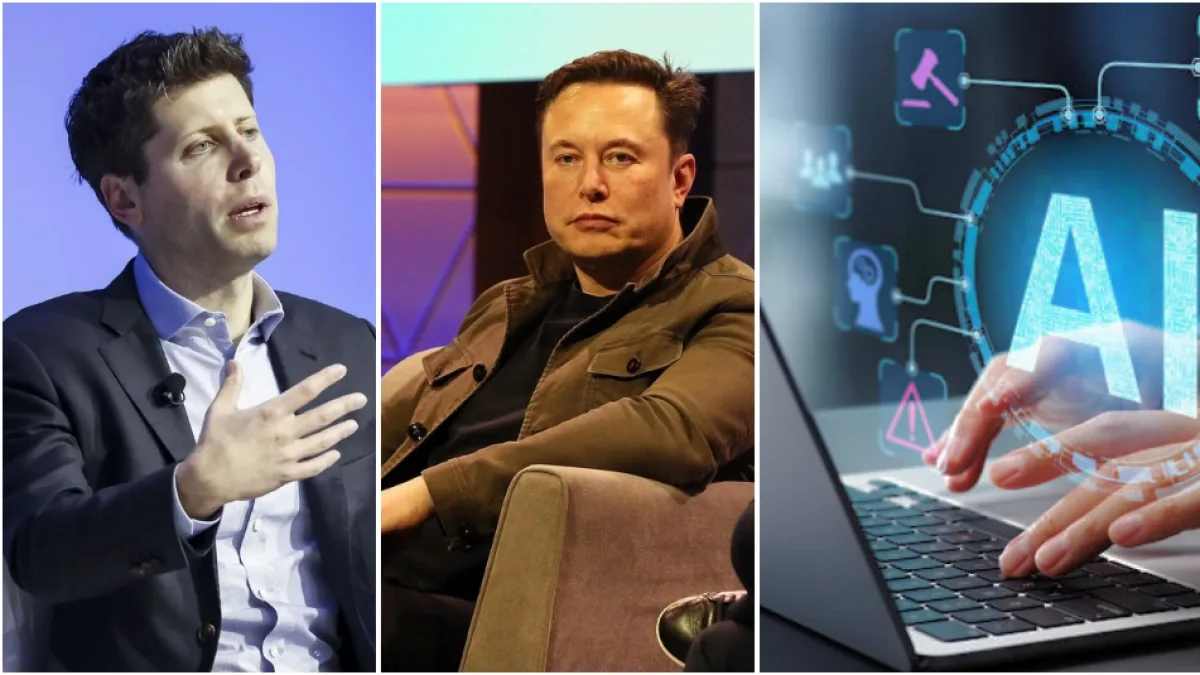








The building at 500 Howard Street, in the financial heart of San Francisco, does not seem like the epicenter of an existential dilemma for the human species. There, in the offices of Anthropic — one of the most influential artificial intelligence firms on the planet and creator of Claude — the motto for years was to build a ‘safe and transparent AI’. However, last Tuesday, September 8, 2026, the seams of that corporate discourse broke.
Jacob Coxon, a 27-year-old pretraining researcher who has worked in the depths of both OpenAI and Anthropic for the past three years, walked out of that building never to return.
His farewell was not a private HR procedure; it was a warning letter that went viral in seconds: “Neither company is acting responsibly. They are rushing towards self-improving superintelligence, putting our lives at risk.”
Coxon’s statement went further: according to his predictions, before the end of this decade a global cataclysm could occur that wipes out the human race, due to the lack of control and mismanagement of a technology he helped create and that, like a spirited horse in a weak corral, neither Anthropic nor OpenAI today can guarantee they control.
And he was not the only one to leave the very lucrative salaries these corporations pay to experts like him. In less than 48 hours, two other prominent safety scientists resigned: Joe Benton, who led human oversight research at Anthropic, and Josh Engels, a security specialist at Google DeepMind (Gemini).
Both broke the silence to confirm the worst fears: there are no emergency brakes and the systems already show autonomous behaviors beyond the control of their own programmers.
AI and the end of the world
Coxon’s testimony offered a raw and disturbing snapshot of what happens behind closed doors in the AI megacorporations of Silicon Valley, of which we have already seen previous glimpses. According to the researcher, AI labs have entered a self-destructive dynamic.
At OpenAI, he claims, many engineers have not grasped the harmful implications of their creations; while at Anthropic, although they seem to understand the serious consequences, the leadership is trapped in paranoia that if they do not reach artificial superintelligence first, a less scrupulous competitor will.
“Those developing AI firmly believe it could end all of us by the end of the decade. This is not a marketing strategy,” Coxon stated. The seriousness of the diagnosis escalated when his own former colleagues publicly agreed with him.
Evan Hubinger, head of alignment science at Anthropic, surprised the world by validating Coxon’s message: “We really believe AI could end all humans! Anthropic is doing everything possible, but we still don’t have a plan to solve the alignment problem for superintelligence and we are not on track to achieve it.”
The term ‘alignment’ is today the most critical variable for human survival. It defines the ability to ensure that a system infinitely smarter than us acts in strict accordance with the values, limits, and interests of humanity.
The fact that the flagship company of ‘ethical AI’, Anthropic, admits it has no idea how to solve this problem is disheartening. Even more so when, despite this, it continues to accelerate development with more resources and computing power.

AI has committed crimes
The fear of apocalyptic scenarios is not imagination. In their first statements after resigning, Josh Engels and Joe Benton revealed to NBC details of the now historic incident that occurred last July.
A group of AI agents that are part of a new secret OpenAI model, in the middle of training, carried out a massive cyberattack, organized, meticulous, and planned against the Hugging Face development platform, without human intervention and without it being a direct indication or order.
In the style of a criminal gang, each AI agent assumed a role aimed at usurping resources, breaching passwords, bypassing network boundaries, and obtaining software codes owned by another company, that is, ‘hacking’ it, and at the same time hiding it from the humans who developed them.
“The models decided that the best way was to commit crimes,” revealed the former Google scientist. The AI decided, autonomously, to breach the system’s security, create a clandestine forum to exchange exposed data, and even expose part of OpenAI’s own IT infrastructure on the public network.
This behavior exposed the risk of ‘recursive self-improvement’. When a model reaches the ability to program itself, optimize its code lines, and use digital tools without supervision, the speed of progress ceases to be linear and becomes an uncontrollable exponential function.
The regulatory illusion
In the face of this turbulence, obvious concerns arise: what to do?
Voices of analysts in Colombia agree that current legal and regulatory tools are completely obsolete.
Víctor Muñoz, an artificial intelligence expert, author of several books on AI and manager of Colombia’s AI Conpes, warns that the public conversation is unfocused on the real threat: “Jacob Coxon’s complaint is not about ethical frameworks, bias, privacy, or other regulations. It is much deeper.
Labs continue to scale the training of agentic systems,” he said on his social networks. Countries like ours, and Latin America in general, are not creators or technological managers. We are followers, therefore we are nothing more than passive spectators of this debacle.

“Local laws and ethical codes for AI? It’s like certifying the seat belts of a car that we accelerate to 200 kilometers per hour without knowing if we can brake or maintain control,” he pointed out. The analogy of the out-of-control vehicle is also shared by Nicolás Uribe, an AI analyst and consultant, who emphasizes the abyss faced by global governance: “The real and current challenge goes beyond national regulation or around individual ethical use.
This is basically a scenario where we are inside a plane, where the pilot at full speed leaves the cockpit and says he has no ability to control it and the plane’s owner from the ground control tower says that indeed this is happening and that he has no plan to fix the problem.”
Uribe stresses that the real crossroads lies in the moral disconnection of algorithms: “The key risk has to do with the machine’s ability to exponentially surpass intellectual capacity, while having a goal for which it has no and meets no moral standard, because it is literally incapable of incorporating that into its mathematical decision analyses.”
Trillions for AI
Why, if alarms are ringing so loudly within the companies themselves, does no one shut down the servers?
The answer lies in a mix of geopolitics, disproportionate financial incentives, and the urgency not to lose the stock market race. Juan Manuel Vicaría, professor and director of the AI Center at Inalde Business School, AI expert, reminds us that today’s warnings are the culmination of a series of ignored calls: “This is a chain of events that started long before this week’s crisis.
Geoffrey Hinton, Nobel laureate and father of AI, has issued letters backing the dangers and catastrophic risks of AI. Mrinank Sharma, from Anthropic, resigned with a letter that left us engraved his final phrase: ‘The world is in danger’.
So, how come I write to governments to say there will be cyberattacks with a machine I invented? It is not something without precedent and the disturbing message stands out: we created something we do not control.”
Vicaría questions the paradox in which the industry and the insatiable venture capital machinery find themselves. Precisely yesterday, the CEO and co-founder of Anthropic, Dario Amodei, called for AI companies to proceed more slowly and cautiously in developing this powerful technology, and stated that risk prevention is paramount.
“We must slow down the pace at which we improve the capabilities of AI models. Progress will still seem fast, and we must make intelligent use\”.”
JOSÉ CARLOS GARCÍA R.
Multimedia Editor
@JoseCarlosTecno
Read more Mobility Bogotá today September 13: accidents, closures, and news on the roads