





Seismic activity continues in Chocó more than a month after the magnitude 7.4 earthquake recorded last August 10.
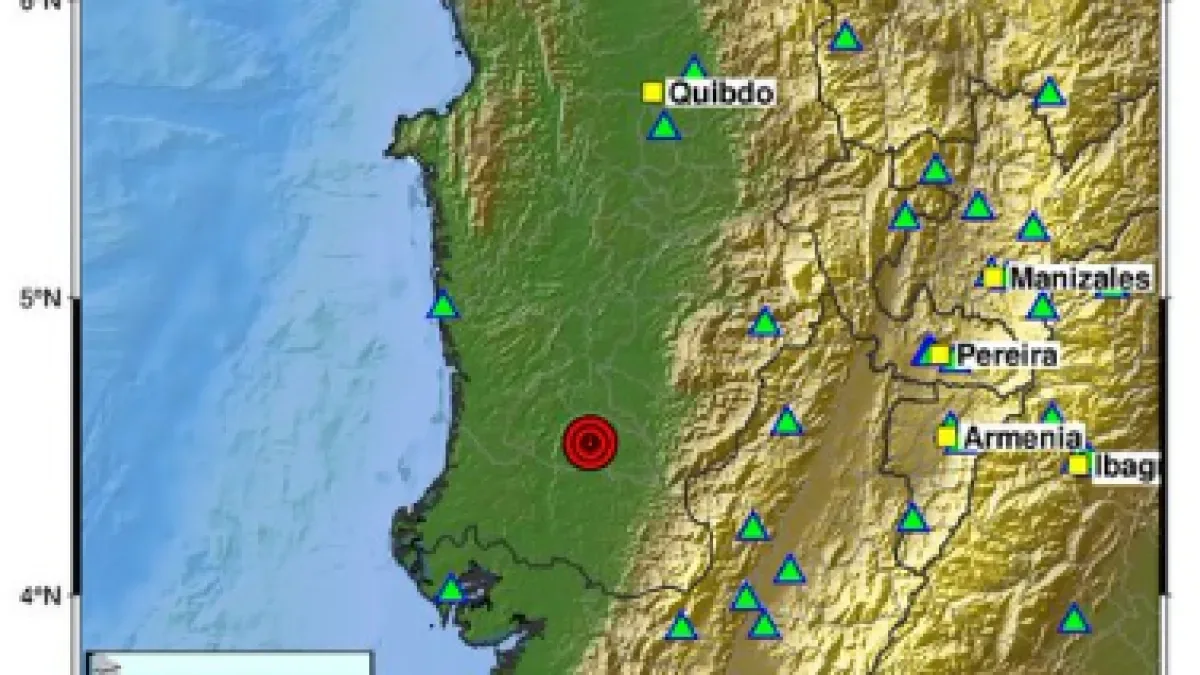
This Sunday, September 14, the Colombian Geological Service reported several earthquakes with magnitudes above 4.0 and epicenter in Istmina, in a new day of movements that were felt in different departments of the country.

According to Freddy Tovar, coordinator of the National Seismological Network of Colombia, these events are part of the seismic swarmthat the Colombian Geological Service identified and reported two weeks ago, within the sequence of activity that has been recorded after the August earthquake.
(Also: Earthquake today in Colombia | Geological Service explained the origin of the series of earthquakes in Chocó and revealed why the tremors are concentrated in that area)
How many earthquakes have occurred since yesterday?
During the afternoon of September 14, three earthquakes with magnitudes above 4.0 occurred in less than six minutes.
The first occurred at 3:02 p.m., had a magnitude of 4.9 and a depth of 39 kilometers. At 3:08 p.m., another movement was recorded, with a magnitude of 4.4 and 40 kilometers depth, while at 3:15 p.m. a third earthquake occurred, with a magnitude of 4.1 and 41 kilometers depth.
An hour later, at 4:13 p.m., another earthquake of magnitude 4.9 and 39 kilometers depth occurred, again with epicenter in Istmina.
According to Tovar, by 4:30 p.m. on September 14, the National Seismological Network had received more than 2,000 felt reports, mainly from Valle del Cauca, Chocó, Risaralda, Antioquia, and Tolima.

Why does it keep shaking in Chocó?
The Colombian Geological Service explains that, after the August 10 earthquake, two groups of earthquakes were identified. The first corresponds to the aftershocks of the magnitude 7.4 event, whose movements have had depths between 70 and 120 kilometers.
The second corresponds to the seismic swarm, to which the movements recorded on September 14 belong.
The difference lies in the way each sequence behaves. Tovar explained that, unlike aftershocks, a seismic swarm does not have a single main event.
What is a seismic swarm?
“A seismic swarm is a sequence of earthquakes that, unlike aftershocks, does not have a main event from which magnitudes decrease,” said the coordinator of the National Seismological Network.
Therefore, the activity can present movements of different magnitudes during its development. “Here we have constant seismicity where we can have seismic events with greater or lesser magnitudes,” explained Tovar.
This characteristic also helps understand why the activity does not necessarily disappear after a few days. According to the official, a seismic swarm can last for different periods of time.

“A seismic swarm can last days, weeks, or months and then disappear,” he stated.
The occurrence of new earthquakes does not by itself mean that it is possible to establish how the activity will continue. The Colombian Geological Service also reminds that earthquakes cannot be predicted.
For now, the National Seismological Network continues monitoring seismic activity and asks the population to consult the information disseminated through the official channels of the Colombian Geological Service.
The Colombian Geological Service stated that it will continue informing about the country’s seismic activity and will promptly report any relevant news.
VIDA DE HOY EDITORIAL