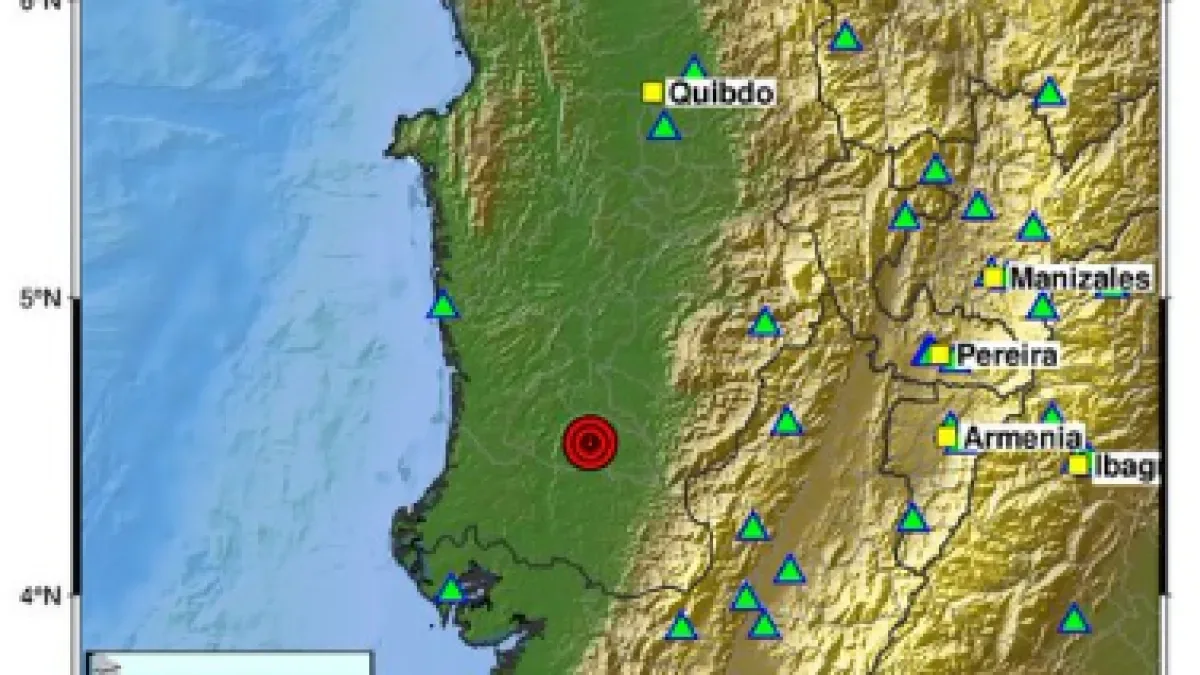






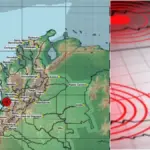

This September 10 marks one month since the magnitude 7.4 earthquake that had its epicenter in San José del Palmar, Chocó.
During these weeks, the Colombian Geological Service (SGC) has been monitoring seismic activity in the department and has conducted fieldwork to establish the effects left by the movement.
According to the report delivered by Freddy Tovar, coordinator of the National Seismological Network of Colombia, as of this Thursday, more than 300 aftershocks associated with the August 10 earthquake have been identified, all with depths greater than 70 kilometers.

Added to these events is a seismic swarm identified in Chocó, which records more than 1,200 events at depths less than 70 kilometers.
Monitoring has not been limited to recording seismic movements. SGC teams have visited more than 20 municipalities and cities to assess the effects of the earthquake. Among the places visited are Quindío, Versalles, Viterbo, Trujillo, Manizales, Cali, and Pereira.
During these sessions, the teams evaluated the intensity of the movement based on people’s perception, the damage to buildings, and the effects observed directly on the ground.
According to the SGC, the greatest damage was found in vulnerable, old, or poorly maintained constructions.
Among them, houses built with bahareque, rammed earth, or adobe were identified, some with heavy roofs and deteriorated structures. Damage was also observed in buildings located in slope areas.
Fieldwork also allowed for the maintenance of five permanent stations of the National Seismological Network located in Chocó and Valle del Cauca.

Measurements were also taken to understand changes in the Earth’s crust. The deformation study network used eight episodic GNSS stations, which recorded information over periods between 96 and 120 hours.
This data allows measuring displacements and establishing areas where greater crustal deformation occurs.
Another result of the monitoring corresponds to mass movements. Through the analysis of satellite images, the SGC identified 240 mass movements, of which 81 were reactivated by the earthquake. These were mainly located in Chocó, Valle del Cauca, Risaralda, Caldas, and Tolima.

The National Seismological Network continues monitoring seismic activity and analyzing the information obtained both from the stations and the fieldwork conducted.
The objective, according to the SGC, is to continue generating scientific information that helps understand what happened and contribute knowledge for risk management, decision-making, and the protection of life and territory.
REDACCIÓN VIDA DE HOY